
Determining the right sample size is important in research and surveys. A small sample may not reflect the real situation, while a large one can waste time and money. To help you find the right number, this tool combines Slovin’s, Cochran’s, and Taro Yamane’s sample size calculators in one place. It’s simple and easy to use. Just select the formula you want, enter the required data, and click calculate. Your sample size will appear instantly. Try the sample size calculator below to make your research more reliable and accurate. Use it now to find the perfect sample size for your study.
Sample Size Calculator – Combines Slovin’s, Cochran’s, and Taro Yamane Methods
Finding the right sample size has never been easier. Use our free, all-in-one sample size calculator below to get accurate results quickly. Simply select your preferred formula—Slovin’s, Cochran’s, or Taro Yamane—then enter the required information. The calculator will automatically show the fields you need to fill in. No confusion, no guesswork. Get your perfect sample size in seconds!
How to Use Our Free Sample Size Calculator
Using this online sample size calculator is quick and easy. Just follow these simple steps:
- Choose the formula you want to use from the drop-down menu.
- Enter the information the calculator asks for. Only the important boxes will appear.
- Then, click the “Calculate” button.
NOTE: The calculator will give you the sample size you need. It only shows the fields needed for the chosen formula. This makes it simple and fast for everyone to use.
Explanation of Key Sample Size Formulas | Cochran’s, Slovin’s, and Yamane Formula
Each sample size formula is designed for a specific situation. Let’s look at how each one works and when you should use it.
1. Slovin’s Formula
Slovin’s formula is great when you have a large population but only limited information about it. It’s a quick way to estimate the right sample size without much hassle. Many researchers choose Slovin’s formula because it’s simple and easy to understand.
The formula is: n = N / (1 + Ne2)
where:
- n is the required sample size
- N is the total population size
- e is the margin of error (usually a small number like 0.05 for 5% error)
To learn more and use this formula in detail, check out our Slovin’s formula sample size calculator guide, which includes Slovin’s formula, how to calculate sample size using Slovin’s formula by hand, a free calculator, and its use case.
2. Cochran’s Formula
Cochran’s formula is best for estimating sample sizes for surveys and large populations. It is especially useful when you want a statistically valid sample with known confidence levels and precision.
There are two variations of Cochran’s formula:
Infinite Population
For very large populations, the basic formula is:
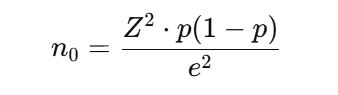
where:
- n0 is the required sample size
- Z is the z-score (based on confidence level, e.g. 1.96 for 95% confidence)
- p is the estimated proportion of the population (like 0.5 if you don’t know it)
- e is the margin of error
Finite Population
When you have a finite population, the sample size is adjusted using the formula:

Where:
- n is the adjusted sample size for finite population
- n₀ is the initial sample size (from the infinite formula)
- N is the population size
To learn more about this method and use it with a free calculator, visit our Cochran’s sample size calculator guide. It explains Cochran’s formula, step-by-step calculation, and its best use cases.
3. Taro Yamane’s Formula
Taro Yamane’s formula is simple and very similar to Slovin’s formula. It works well when you’re dealing with large populations and want a quick, reliable estimate.
The Yamane sample size formula is used to determine the minimum sample size needed for a survey or study when the population size is known and a desired level of precision is specified.
The formula is: n = N / (1 + Ne2)
where:
- n is the sample size
- N is the total population size
- e is the margin of error
For more details and a free calculator, check out our Taro Yamane sample size calculator guide. It covers the formula, how to calculate it by hand, and real-world use cases.
Tips for Choosing the Right Sample Size Formula for Your Research
Choosing the right formula depends on your research goals and the information you have available. Here’s a simple guide to help you pick the best approach:
- Slovin’s Formula: Best when you have limited information and need a quick estimate for a large population. It’s straightforward and commonly used in classroom or field surveys.
- Cochran’s Formula: Ideal for surveys that require more precise estimates. Use it if you know the expected proportion (p) and have a clear confidence level in mind. It’s more detailed and can handle infinite or finite populations.
- Taro Yamane’s Formula: Practical and similar to Slovin’s. It’s another go-to method for large populations when you want a simplified approach.
By matching the formula to your research situation, you ensure accurate and reliable sample sizes for your study.
Frequently Asked Questions (FAQs)
A sample size calculator helps you determine the minimum number of participants needed for a survey or study. It uses mathematical formulas to ensure your sample is large enough to draw reliable conclusions.
Slovin’s formula uses the population size and a margin of error to estimate the sample size. It’s simple and works well for large populations when you don’t have much other data.
Use Cochran’s formula when you want a more precise estimate and know the expected proportion of your population and confidence level. It’s great for large surveys and reliable results.
There’s no actual difference — they use the exact same formula to calculate sample size. It’s just a matter of naming: some refer to it as Slovin’s formula, while others call it Taro Yamane’s formula.
These calculators provide solid estimates based on statistical formulas. However, always consider your specific research context, available data, and practical limitations.
Yes, but with caution! They’re designed for quantitative research, especially surveys and polls. Qualitative or complex studies might need different approaches.
Ready to find the perfect sample size for your research?
Use our easy, all-in-one Sample Size Calculator above to get accurate results instantly.
Have questions or need personalized help with your data analysis?

